AI pet robot products are moving beyond novelty, combining expressive movement, voice interaction, sensors, and app-based controls. Their appeal is easy to picture: a small robot turns toward a voice, blinks, and follows someone across a living room. Yet dependable performance matters more than a cute demo. Battery life, privacy controls, repair support, and reliable behavior shape the experience at home.
Industry data offers useful context, but not a direct measure of this niche. The International Federation of Robotics’ World Robotics 2024 report recorded nearly 205,000 professional service robots sold worldwide in 2023, up 30% year over year. That figure covers many service-robot applications, not pet robots alone. The IFR’s World Robotics 2023 report also helps explain why broad robotics growth should not be mistaken for proof of demand in every consumer category. A gap remains.
This guide examines ten manufacturers in China through practical signals: product range, disclosed technical features, manufacturing presence, and available customer support. Company information and product claims can change, while independent testing of AI pet robots remains limited. The list is therefore a market overview, not a laboratory ranking or guarantee of performance. Buyers should compare real interaction quality, safety features, software updates, and after-sales terms. A polished launch video is not enough. That distinction deserves attention.
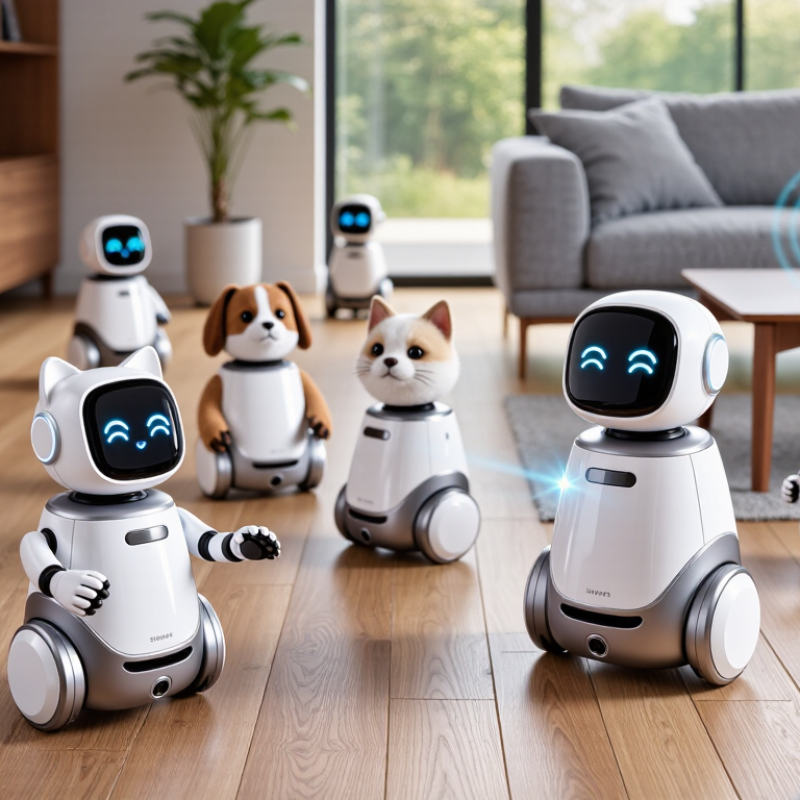
AI pet robots are interactive machines designed to imitate selected animal behaviors, not simply toys with fur. Their defining features may include microphones, cameras, touch sensors, and software that responds to voices, movement, or handling. A device that only repeats fixed sounds is better described as an electronic toy; adaptive responses offer stronger evidence of AI, though “AI” is not always used consistently in product descriptions.
Classification works best across two dimensions: function and autonomy. Function-based groups include companion robots, play-focused robots, and care-oriented devices that remind users about routines. Autonomy ranges from button-triggered actions to sensor-led responses and systems that adapt to repeated interactions. A soft exterior may suggest companionship, while rolling movement, blinking lights, and a turning head reveal the hardware underneath. These distinctions matter when comparing manufacturers.
The International Federation of Robotics’ World Robotics 2024 report recorded nearly 205,000 professional service robot sales in 2023, up 30% year over year. It also reported 19 million personal and domestic service robots sold, up 11%. These figures provide context, not a pet-robot sales count: the report does not isolate AI pet robots as a separate market category. That gap makes precise comparisons difficult. Still, buyers and analysts can assess sensor types, response quality, safety testing, and whether advertised learning happens on the device or through connected services. One detail is easy to miss: lifelike movement does not prove genuine adaptive intelligence.
A credible manufacturer should prove more than a convincing prototype. Ask for production-line records, component traceability, and inspection results from recent batches. For a pet robot, check how reliably it navigates around chair legs, responds to touch, and handles repeated charging. Request battery-cycle and drop-test results, plus measured noise levels in decibels. Small details matter: a loose wheel, loud motor, or unreliable sensor can quickly undermine a pet owner’s trust. Factory visits or independent audits can help verify that documented procedures match actual production.
Market data offers context, not a shortcut. The International Federation of Robotics reported that 2023 global sales reached about 205,000 professional service robots, up 30% year over year, and 19.1 million consumer service robots, up 11% (World Robotics 2024). These figures do not isolate pet robots, so they should not be treated as proof of demand for any specific product. Still, they highlight the value of assessing real-world reliability and after-sales support. Ask manufacturers for repair turnaround times, spare-parts availability, and software-update policies. Review their privacy and cybersecurity practices, especially when devices use cameras, microphones, or connected apps. No checklist is perfect. A missed flaw is possible, so test production units—not only polished samples.
China’s AI pet robot market includes manufacturers with different strengths, from expressive companion designs to practical production engineering. A useful overview of ten leading candidates should compare what each can actually deliver, rather than treat “AI” as a complete measure of quality. Some teams focus on lifelike movement, soft-touch shells, and responsive sounds. Others emphasize voice interaction, sensor integration, or stable high-volume assembly. Their products may look similar in photos, but a robot’s turning radius, motor noise, and response time can vary noticeably.
For a fair comparison, examine working samples and ask how features perform in ordinary home settings. Test voice commands from across a room, observe movement on rugs, and check whether the robot reacts consistently after repeated interactions. Request clear specifications for battery life, charging time, materials, and after-sales support. Also ask which functions work offline and which depend on an app or network connection. A polished demonstration is useful, but it cannot replace repeated testing. Rankings can look tidy on paper; real samples may disagree.
Tips: Compare the same tasks across suppliers. Record noise, response delays, and battery performance. Small details matter. Do not rely on promotional videos alone.
A useful profile of China’s AI pet robot manufacturers looks beyond appearance. It asks what each maker builds best, how the robot responds, and whether daily use feels practical. One maker may focus on a soft, plush-bodied companion that reacts to touch. Another may specialize in a wheeled pet with expressive eyes, obstacle sensors, and a compact charging dock. Some products emphasize voice interaction, while others use simple movement and sound. Small details matter: a quiet motor, a stable base, or a shell that is easy to wipe clean.
Signature products also reveal different engineering priorities. A camera-equipped companion may support remote check-ins, while a desktop pet might offer gestures and short conversations without taking much space. Educational models can combine basic coding activities with playful movement. A more lifelike design may prioritize facial expressions and responsive ears. These features are not equal measures of quality. A long feature list can still feel awkward in a living room.
Comparing ten manufacturers fairly means checking demonstrations, materials, interaction limits, and after-sales support. Product claims should be tested in ordinary settings, not only polished promotional videos. I would want to see how a robot behaves after repeated use, and how clearly its functions are explained. Rankings can be useful, but they are imperfect; a signature product may suit one household and frustrate another.
Comparing China’s leading AI pet-robot manufacturers works better by technology and use case than by a single ranking. Some focus on expressive movement: a head tilt, soft eye animation, or a small turn toward a familiar voice. Others prioritize sensors, cameras, and mobile bases for home monitoring or interactive play. These designs serve different needs. A lively companion may matter more than advanced navigation; for an older pet, quiet movement and predictable behavior can matter more.
The International Federation of Robotics’ World Robotics 2024 report recorded more than 205,000 professional service robots sold in 2023, up 30% year over year. That figure does not measure pet robots specifically. It does show growing use of service robotics, a useful but broad comparison. For pet devices, buyers should examine response speed, obstacle handling, sound levels, battery life, and whether core features work without a constant internet connection. A robot that crosses a rug reliably may be more useful than one with many clever modes.
Manufacturers also differ in how they handle interaction. Camera-led models can support remote check-ins, while voice and motion recognition can make play feel more responsive. Yet a moving toy is not a substitute for care or companionship. Testing conditions matter, too: a smooth showroom floor says little about fur, cables, or a cramped apartment. That gap deserves more attention.
A qualitative comparison of how common AI pet robot capabilities fit different use cases. Scores use a 1–5 editorial scale; they are illustrative, not measured or verified manufacturer data.
Higher scores indicate a stronger fit for the use case, not a ranking of companies or products. Companion interaction emphasizes speech and expressive response, while remote monitoring relies more on vision and connectivity.
It uses sensors and software to respond to voices, movement, or touch. A toy that only repeats fixed sounds is less adaptive. The label can be fuzzy.
Common types include companion robots, play-focused robots, and devices that remind users about routines. Some roll across floors; others mainly animate their eyes or heads.
Some act only after a button press. Others respond to sensors or adjust to repeated interactions. A turning head alone proves little.
No. A lifelike head tilt may be pre-programmed. Check whether the device adapts, and where that processing happens.
Check response speed, obstacle handling, sound levels, and battery life. Also ask whether core features work without constant internet access.
Cameras may support remote check-ins, while voice and motion sensors can make play more responsive. Privacy and practical usefulness deserve equal attention.
No. A 2024 industry report recorded about 205,000 professional service robots sold in 2023, plus 19 million personal and domestic service robots. It did not separate AI pet robots.
Test it on rugs and near cables, not only on a smooth showroom floor. A quiet robot that crosses a rug reliably may be more useful than one with many modes. I might be overvaluing quietness, though.
No. It can offer interaction, but it is not a substitute for care or companionship. A useful limit to remember.
This article explores how an AI pet robot combines artificial intelligence, sensors, and interactive design to imitate aspects of a companion animal. It explains common ways these devices are classified, such as by their form, mobility, interaction style, and intended setting. It also outlines practical criteria for assessing manufacturers in China, including product functionality, engineering capability, reliability, customization options, and support.
The article then presents an overview of ten manufacturers and their signature product types, without treating every device as suited to the same needs. By comparing technologies and use cases, it highlights how some designs focus on expressive interaction and companionship, while others emphasize mobility, learning, or adaptable features. This framework can help readers understand the market and choose an AI pet robot according to their priorities, whether for personal enjoyment, education, or other everyday settings.